
Murchison Falls: The Complete UK Traveller’s Guide
Ogundeyi Faith
Murchison Falls National Park: Wildlife, the Waterfall, and Why Nothing Prepares You for It
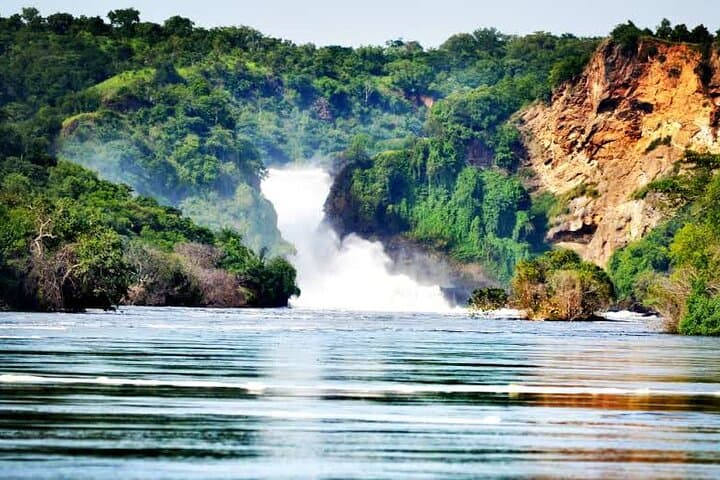
You hear it before you see it. A deep, bass roar that you feel in your sternum before your brain registers what it is. Then the spray hits. Cold and total. Then you see the Nile — the longest river in the world — forcing its entire body through a gap seven metres wide and dropping 43 metres into the Devil’s Cauldron below.
This is Murchison Falls. And nothing you read prepared you for it.
For UK travellers planning a Uganda safari, Murchison Falls National Park often begins as a line on an itinerary. But the reality, when you finally stand here, is something far more physical. The air hums. The ground trembles. The Nile does not flow — it surges, compresses, and detonates.
This is Uganda’s largest national park, covering 3,893 square kilometres. It was first gazetted as a game reserve in 1926 and today supports 144 mammal species and 556 bird species. The Nile splits it into two distinct worlds; dense southern forest and open northern savannah — shaping everything from wildlife movement to how you experience the land.
Murchison Falls Uganda is not a place you pass through. It is a place that stays with you.
The waterfall — what makes it the most powerful in Africa
The title sounds dramatic until you stand at the edge and realise it might actually be an understatement.
Murchison Falls is widely recognised as the most powerful waterfall in Africa, not because of its height alone, but because of what happens in that narrow gap. The entire Victoria Nile forced through a 7-metre gap, dropping 43 metres into the Devil’s Cauldron below.
Around 300 cubic metres of water pass through every second.
The effect is immediate. The pressure creates constant mist that hangs in the air like breath on cold glass and forms a permanent rainbow.
In 1864, explorer Samuel Baker named the falls after Roderick Murchison, describing it as “the most important object through the entire course of the river.” Even now, that feels less like a description and more like a warning.
There are two ways to experience it, and I didn’t realise how different they would feel until I stood in both places.
At the top, I remember thinking I was prepared. I’d seen photos and read descriptions. But the moment I got closer, all of that disappeared.
The path was wet, the air already heavy with mist, and then suddenly the Nile was right there beneath my feet; not flowing, but forcing itself through that narrow gap with a kind of urgency that felt almost unreal.
The spray hit my face instantly. My clothes started to cling. I tried to stand still and take it in, but it was too much to absorb at once. It felt less like watching a waterfall and more like stepping into something alive.
Later, at the bottom during the boat cruise, everything changed. I was looking up this time.
The falls felt taller, and almost overwhelming in a different way. The gorge seemed tighter, the sound deeper, and the water crashed into the Devil’s Cauldron in this constant, churning motion that didn’t let up for a second. I remember just standing there, not even trying to take photos anymore, just watching it happen.
By the time I left, I realised it’s not one experience, it changes completely depending on where you stand.
The wildlife — what you will actually see
People researching wildlife in Murchison Falls National Park often ask the same question: what animals are in Murchison Falls National Park?
The answer is reassuringly straightforward.
Murchison supports 144 mammal species and 556 bird species, alongside Uganda’s largest population of Nile crocodiles. It is one of the few places in East Africa where wildlife still feels expansive, not compressed into small viewing areas.
Elephants are often the first to appear. Herds move steadily across the northern plains, sometimes crossing directly in front of vehicles with complete indifference. Buffalo follow a similar pattern — large, dark herds gathering in numbers that feel almost overwhelming when seen up close.
Lions are here in healthy numbers, though never guaranteed. They favour the long grasslands where Uganda kob graze, often resting under acacia trees during the day before becoming active at dawn and dusk.
Leopards remain the most elusive of the large predators. Sightings do happen, particularly around Pakuba lodge, but they require patience, timing and a little luck.
Then there are the Rothschild’s giraffes.
This endangered subspecies survives in relatively few places, but in Murchison Falls National Park, they move in large, visible herds across the northern savannah. Watching them in the soft evening light is one of those moments that quietly defines a Uganda safari.
The Nile itself tells a different story.
Hippos crowd the water in dense pods, their low grunts carrying across the river long before they surface. Nile crocodiles line the banks, motionless and immense, some among the largest in Uganda.
You may also notice something unusual moving across the grasslands — the patas monkey, a species found in very few places in Uganda and particularly associated with Murchison’s northern plains.
Birdlife is constant. African fish eagles call from riverside trees. Goliath herons stalk the shallows. Red-throated bee-eaters flash across sandy banks. And for many travellers, the most sought-after sighting is the shoebill stork, best searched for on the Nile-Lake Albert Delta cruise. You can learn more about it here.
Beyond the savannah, the forests deepen the experience. Budongo Forest and Kaniyo Pabidi together hold around 800 chimpanzees, making chimpanzee trekking Murchison Falls one of the most rewarding, and least crowded, primate experiences in Uganda.
The boat cruise — the experience that defines the park
The Murchison Falls boat cruise isn’t just one of the activities in Murchison Falls National Park, it’s the experience that quietly defines everything else around it. A Murchison Falls boat cruise along the Nile, or a Nile boat cruise Uganda visitors often talk about, doesn’t scatter the experience; it concentrates it, bringing wildlife and landscape into close, unfiltered view.
The journey starts at Paraa and heads 17 kilometres upstream to the base of the falls, taking about three hours round trip. Boats leave at 9:00am and 2:00pm. Mornings offer softer light that’s ideal for photography, while afternoons often reveal more animal activity as the heat drops.
Out on the water, the river becomes the stage. Hippos cluster in dense pods, surfacing and sinking in slow rhythm. Nile crocodiles lie motionless along the banks. Elephants come down to drink, buffalo move in vast herds, and giraffes stand further back, stretching above the treeline. Overhead, Goliath herons, African fish eagles, and red-throated bee-eaters cut through the sky in steady rhythm.
As the boat nears the falls, everything changes. First comes the sound, then the mist, then the force. At the base, you disembark and walk to a viewpoint where the Nile compresses into a roaring churn of water known as the Devil’s Cauldron. The noise lands deep; something you feel in your chest more than you hear.
A second option runs downstream toward the Nile–Lake Albert Delta, a longer 20km, 4–5 hour cruise and one of the best places in East Africa to see the shoebill stork in the wild.
Those who experience both morning and afternoon cruises during a multi-day stay often say they feel like completely different journeys — and it’s usually here that people start thinking more carefully about how they plan their time in Murchison Falls.
Game drives — north bank savannah at dawn
Before the sun fully breaks, the north bank of Murchison Falls National Park is already stirring — and this is where Murchison Falls game drives begin to feel like a true safari unfolding in real time. Among the most memorable Murchison Falls National Park activities, this stretch of savannah opens into wide grasslands, Borassus palms, and scattered acacia woodland that glow differently with every passing minute of dawn.
Dawn is the most beautiful light in the park, the sun rises rapidly, first pale grey then gold. Uganda kob appear almost everywhere across the plains, while giraffes move steadily across the horizon and elephants trace slow paths through the grass.
Morning and evening drives both deliver strong sightings, but the mood shifts completely. Mornings feel fresh and alert, with animals more active, while evenings are slower, softer, and more relaxed as the heat fades. The quieter Honeymoon Track is also a favourite for guides tracking leopards.
A typical drive may reveal Uganda kob scattered across the plains, giraffes moving in long silhouettes, elephants, buffalo, warthog, oribi, and waterbuck. Lions are part of the landscape too — present, but never promised — keeping wildlife in Murchison Falls National Park unpredictable in the best way.
Other activities — hiking, fishing, chimpanzees
Beyond the main safari experience, there are several things to do in Murchison Falls that reveal the park from completely different angles.
The hike to the top of the falls takes about 45 minutes and leads you right to the edge of the gorge, where mist rises and the river thunders below.
Nile fishing offers the chance to catch enormous Nile perch, sometimes reaching 40–50kg, while hippos and crocodiles remain in view throughout.
Chimpanzee trekking in Murchison Falls takes place in Budongo Forest and Kaniyo Pabidi, home to over 600 chimpanzees, where guided walks track habituated groups through dense forest.
Ziwa Rhino Sanctuary, located en route from Kampala, provides the missing piece of the Big Five before you reach the park.
The elephant who salutes the Nile
Along one stretch of riverbank, guides often slow the boat and gesture quietly toward the trees.
An elephant lives here — one caught in an ivory trap years ago. Rangers saved him, but he lost part of his trunk in the process.
Now, when a tourist boat passes along the Nile, he sometimes steps out of the bush and walks to the water’s edge.
The engine drops to a low hum. Conversations fade. And in that stillness, he lifts what remains of his trunk into the air — just once — then stands there as the boat moves on.
Getting there and practical information
Getting to Murchison Falls from Kampala is about 285km — roughly five hours on the road, depending on traffic leaving the city. The route passes through Masindi, and many travellers pause at Ziwa Rhino Sanctuary along the way, an easy stop that completes the Big Five before you even reach the park.
If you don’t want the long drive, there are small flights from Entebbe into Pakuba, Chobe, or Bugungu airstrips, followed by a short transfer into the park.
Entry is paid at the Uganda Wildlife Authority gate, after which the landscape opens up without much transition. Accommodation ranges from Paraa Safari Lodge and Chobe Safari Lodge to smaller, simpler camps.
The best time to visit Murchison Falls is during the dry seasons — June to September and January to March — when animals gather along the Nile. The park stays open year-round, with greener scenery in the rains.
Temperatures remain around 21–30°C all year. Many travellers continue onward to Kibale for chimps or Queen Elizabeth for a wider circuit, and the trip starts to feel less like a checklist and more like the country unfolding as you move through it.
For many travellers, that’s where their first real understanding of Uganda begins, something explored further here.
By this point, it usually stops feeling like a place you’ve read about, and starts feeling like somewhere you’ve already been.
Most people who visit Murchison Falls say the same thing afterward: they wish they had stayed longer.
Book more days than you think you need. You will use every one of them.
[Plan your Murchison Falls safari ]
[Read: My First Realisation About Uganda ]