
The Bird That Looks Like a Dinosaur: The Shoebill Stork
Ogundeyi Faith
The Bird That Looks Like a Dinosaur: The Shoebill Stork
It doesn’t blink. It doesn’t flinch. It simply watches you — with the kind of stillness that suggests it has been watching things like you come and go for tens of millions of years.
The shoebill stork is the bird that looks like a dinosaur, and once you’ve seen one, that description feels less like hyperbole and more like understatement.
There is one in the UK right now. Her name is Abou. She lives in Devon, behind glass, in an enclosure at Exmoor Zoo. And somewhere in Uganda’s papyrus swamp forty minutes from Entebbe Airport, roughly 1000 more are doing exactly what they’ve always done; standing perfectly still, and waiting.
What is the Shoebill Stork?
Despite its common name, the shoebill is not actually a stork. Its scientific name — Balaeniceps rex, meaning “king whale-head” — tells you more.
Genetically, its closest living relative is the pelican, not any stork species. It sits entirely alone in its own taxonomic family, Balaenicipitidae, with no close relatives alive today.
Its fossil lineage stretches back to the Oligocene epoch — this bird has been here for tens of millions of years — long before humans existed and long before most modern bird families took shape.
So is a shoebill a dinosaur? Not technically. Birds evolved from theropod dinosaurs, making all birds distant descendants. But the shoebill’s ancient lineage and unchanged silhouette make it the closest thing walking — or standing, motionless in a swamp, on earth today.
It went viral for a reason: the stare, the bill, the absolute stillness. It looks like something the Cretaceous misplaced and the modern world never quite reclaimed.
Size, Appearance and the Stare
This is a big bird that looks like a dinosaur, and the numbers confirm it. A shoebill stands up to 152 cm tall, which puts it at shoulder height to most adults. Its wingspan stretches to 260 cm; wider than a king-size bed. Its bill measures up to 24 cm long, making it the third longest of any living bird on earth.
Shoebills’ lifespan ranges between 35 and 50 years — which matches the slow, deliberate pace of everything they do.
That bill is extraordinary up close. Pinkish-grey, broad as a boot, with a sharply hooked tip and blade-like edges engineered to clamp a thrashing lungfish and simply not release. It is not decorative. It is a weapon that has been refined over millions of years.
Then there are the eyes. Deep-set, yellow, and completely unblinking. The shoebill holds eye contact in a way that feels less like animal behaviour and more like assessment.
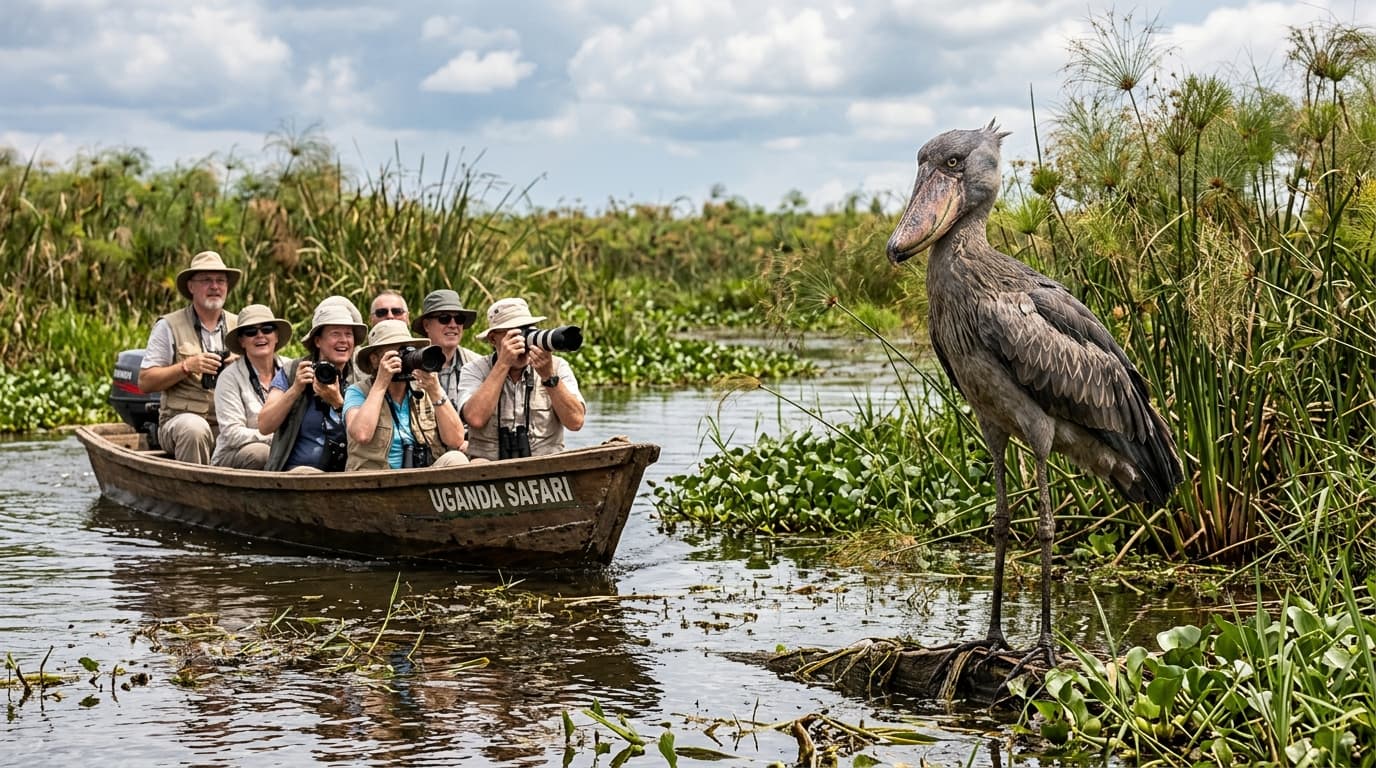
Grey-blue plumage, long dark legs, absolute stillness — standing in a swamp, this giant bird that looks like a dinosaur seems less like a living creature and more like something carved from stone and left there as a warning to smaller animals.
Stand next to one and it reaches your shoulder. This is the image that stops people mid-scroll. Guides in Uganda will confirm what photographs only begin to suggest: you will not win a staring contest with this bird.
Where Do Shoebills Live — and Where Can You Actually See One?
They are found across East and Central Africa — South Sudan, Uganda, the DRC, Tanzania, Zambia — wherever deep freshwater papyrus swamps hold enough lungfish to sustain them.
They do not adapt to degraded habitat. They live where conditions are exactly right, and nowhere else.
Uganda is the best and most reliable country in the world to see a shoebill in the wild. Top locations include Mabamba Swamp on the northern shore of Lake Victoria, Murchison Falls National Park, Ziwa Rhino Sanctuary, and Lake Mburo.
If you’re new to Uganda, this is where most journeys begin.
Now, here is the comparison that puts it into perspective.
In the United Kingdom, there is just one shoebill — her name is Abou, and she lives at Exmoor Zoo in Devon. She is one of only 13 shoebills in captivity worldwide, part of a European breeding programme with just 8 adults.
On cold or wet days, she is kept indoors with limited viewing.
Now compare that to Uganda: approximately 1,000 shoebills moving freely through open papyrus swamps — the largest single concentration on earth, with over 150 breeding pairs.
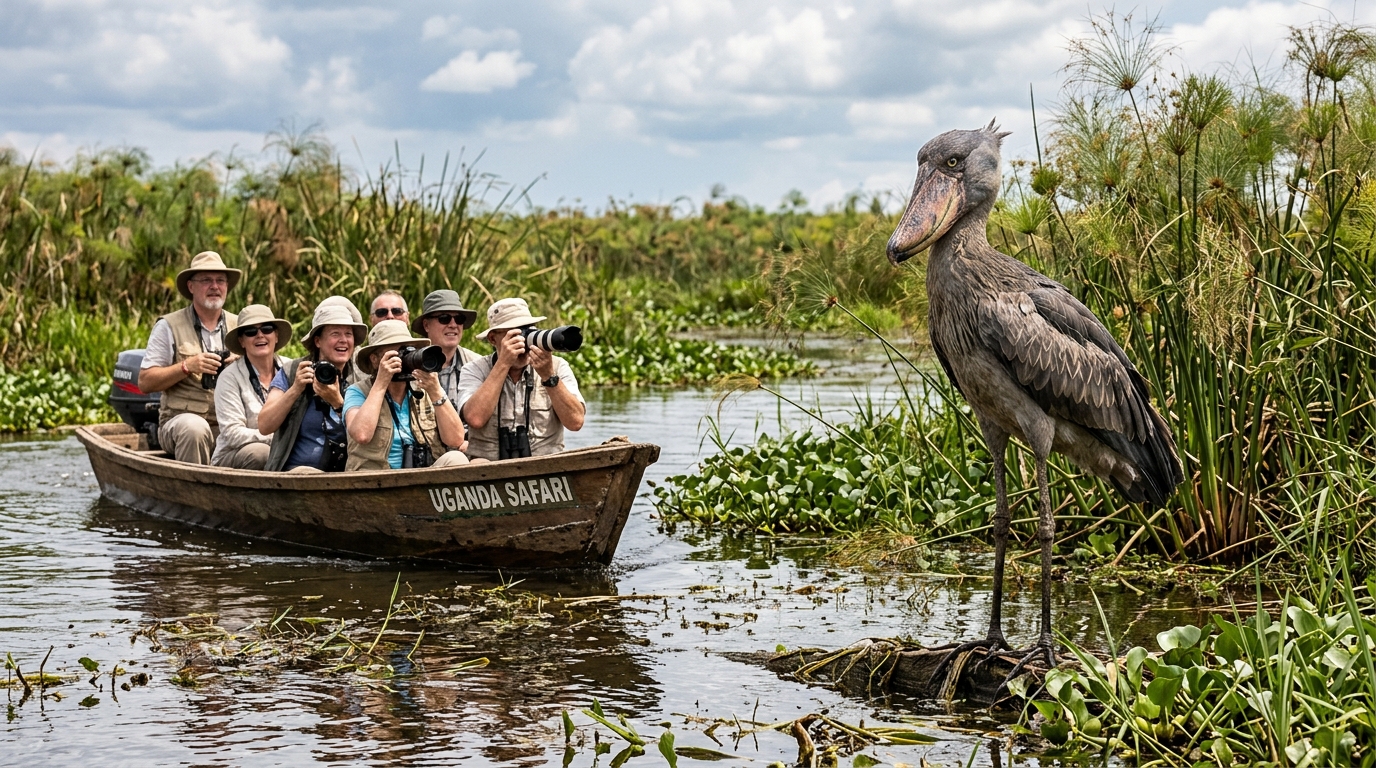
Mabamba Swamp is a Ramsar-protected wetland just 40 minutes from Entebbe Airport. Local guides bring you within metres by canoe, without disturbing them.
There is no glass. No enclosure. You are on the water — and the bird is right there, watching you back.
Are shoebills in Uganda? Yes — and nowhere else offers this level of access.
Behaviour, Diet and the Hunt
The shoebill hunts using a technique with a name that suits it perfectly: Freeze and Seize.
It stands in the shallows, completely motionless, for hours at a stretch — not almost still, not occasionally still, but statue-still, as though time has suspended around it. Then it strikes.
When the strike comes, it arrives with a speed that seems impossible for something this large. The bill snaps shut. The prey— a lungfish, a frog, a baby crocodile, an eel, a water snake, a Nile monitor — had no warning and had no chance.
Larger prey is decapitated before swallowing. Then the stillness returns immediately, as if nothing happened at all.
At close range, one other sound cuts through the quiet of the swamp: the shoebill’s bill-clatter — a sharp, rapid mechanical rattling that guides at Mabamba compared to a burst from a machine gun. It is startling at two metres. You don’t expect it and you won’t forget it.
Can shoebills fly? Yes. The shoebill is not one of the large flightless birds many people assume it to be. It takes to the air on broad wings, soaring on thermals at a flapping rate of around 150 flaps per minute, one of the slowest of any flying bird, but airborne and capable of covering real distance.
Are shoebills dangerous to humans? No. Approached calmly and respectfully, they are docile. At Mabamba, experienced guides bring canoes within metres of actively feeding birds without causing disturbance.
Is the shoebill friendly? Not warm — but it will hold your gaze steadily and, with guides it has grown to recognise, bow its head in what appears to be acknowledgement.
This is the moment people travel for. And it is what no zoo enclosure, however well-run, can replicate.
Conservation — Why Seeing One Matters
Only 3,300 to 5,300 mature shoebills exist on earth. The IUCN classifies the species as Vulnerable, and the global population is in decline.
Do shoebill birds still exist? Yes — but the margin is considerably narrower than most people realise, and it is narrowing further.
The threats are significant. Papyrus wetlands across Central and East Africa are being drained steadily for agricultural use, eliminating the very habitat shoebills cannot live without.
The illegal wildlife trade adds further pressure — a single shoebill chick can fetch thousands of pounds on the black market, making nests a target.
Uganda’s approach at Mabamba offers a genuinely different model. The community guides who take visitors out onto the swamp were former fishermen who once competed with shoebills for lungfish.
Ecotourism changed that relationship entirely. The birds now generate more value alive, present, and protected than they ever did displaced.
Visitor fees support conservation. Local employment funds the families who once fished the same waters. The guides protect the birds because the birds sustain the community.
So when you plan your trip to see a shoebill in Uganda, it isn’t just about the sighting.
It’s a small, real contribution to why they’re still here.