
Karamoja, Uganda: The Cattle People Who Refused to Change
Ogundeyi Faith
Karamoja, Uganda: Who the Karamojong Really Are (Culture, Cattle & Kidepo)
My name does not matter. What matters is that I am Karamojong, and this land — Karamoja in Uganda, in the far northeast — is the only land I have ever needed to understand.
At dawn, before the sun rises fully over the plains, the cattle begin to move. You hear the bells first. Then comes the red dust lifting slowly into the morning air beneath thousands of hooves. Boys call out softly to the herds. Elders sit quietly outside the manyatta watching the day begin the same way their fathers and grandfathers watched it begin before them.
This is not a guide written from Kampala. It is not a brochure trying to make our lives sound exotic. This is simply Karamoja told from within by the Karamojong people who belong to this land and whose lives still move with the rhythm of cattle, seasons, and memory.
If you listen carefully enough, you will understand why we measure wealth in herds, why elders still settle disputes beneath trees, and why this land stays with visitors long after they leave.
Where We Are — The Land of Karamoja
Karamoja region in Uganda stretches across 27,528 square kilometres in the northeastern corner of the country, bordering Kenya to the east and South Sudan to the north. According to the 2024 Uganda National Census by the Uganda Bureau of Statistics (UBOS), the region is home to 1,496,117 people spread across nine districts: Abim, Amudat, Kaabong, Karenga, Kotido, Moroto, Nabilatuk, Nakapiripirit, and Napak.
Moroto, our regional capital, sits beneath Mount Moroto, one of the mountains that shape this land alongside Mount Kadam and Mount Morungole. The mountains rise suddenly from wide open plains where cattle move across grasslands broken by rocky outcrops, thorn trees, and dry riverbeds.
People often describe Karamoja in Uganda as remote.
But remote from what?
The land has always known itself.
We receive one major rainy season, usually between March and October. When the rains come, the plains turn green and cattle grow strong. Then the dry season arrives slowly and stretches for months. Rivers shrink. Dust returns. Men begin moving further with their herds searching for pasture and water.
Development workers once looked at this movement and called it backwardness.
But moving with cattle through a semi-arid environment is not backwardness. It is ecological intelligence refined over centuries.
This is not a harsh land. It is our land.
Who We Are — The Karamojong People
The Karamojong tribe traces its roots to a migration from present-day Ethiopia around 1600 AD. Anthropological records place us within the Ateker cluster — Nilotic-speaking pastoral peoples who spread across parts of Uganda, Kenya, South Sudan, and beyond.
Our name comes from the phrase ekar ngimojong — “the old men can walk no farther.”
That sentence became our identity.
It marked the place where our ancestors stopped walking and chose to settle.
Today, the Karamojong people speak Ngakarimojong, a Nilotic language related to Turkana in Kenya, Teso in Uganda, and Toposa in South Sudan. Our language carries proverbs, oral histories, songs, and stories that preserve memory better than books ever could.
People often ask: Are the Karamojong related to the Maasai?
Yes, distantly.
Both the Maasai and the Karamojong emerged from the same broad Nilotic migration from present-day Ethiopia and southern Sudan centuries ago. One branch moved south into Kenya and Tanzania and became the Maasai cluster. Another branch moved west and became the Ateker peoples, including the Karamojong, Turkana, and Teso.
That shared ancestry still shows itself in cattle-centred life, warrior traditions, adornment, and age-set systems.
Our society remains deeply communal. Elders deliberate and govern through discussion beneath trees. Warriors protect cattle and territory. Women sustain the manyatta, raise children, prepare food, milk cattle, and carry much of daily life on their shoulders.
Many outsiders speak about Karamojong culture as if it belongs to the past.
But we are not a dying people.
We are one of the most intact indigenous cultures in East Africa.
The Cattle — Our Wealth, Our Religion, Our Blood
If you want to understand Karamoja, then understand cattle first.
Everything begins there.
According to cultural records documented by regional tourism and anthropological studies, Karamoja holds an estimated 20% of Uganda’s total cattle population. Here, a man with 200 cows may command greater respect than someone in the city with a large salary and a modern office.
Outsiders count wealth in bank accounts.
The Karamojong count wealth in herds.
To us, cattle are not simply livestock. They are inheritance, identity, social security, dowry, survival, and spiritual connection.
Our god, Akuj, gave us all cattle on earth. That belief shapes how we understand ownership itself. Historically, when cattle were taken from neighbouring groups, many Karamojong saw it not as theft but as reclaiming what Akuj had already entrusted to them.
Every part of a cow matters.
Milk feeds us daily. Blood nourishes us without slaughter. Hides become bedding and clothing. Horns become containers. Dung strengthens walls and floors inside the manyatta. Urine is used for cleansing. Intestines may be examined during ceremonies and spiritual practices.
Nothing is wasted because nothing is separate from life.
Visitors have sometimes described the practice of drinking blood as primitive. But for centuries, the Karamojong people have carefully extracted blood from live cattle without killing them.
So, how do Karamojong extract cow blood?
A specially designed arrow is used to make a small incision in the jugular vein. Blood is collected into a gourd and often mixed with milk before being consumed. Afterwards, the wound is sealed and the cow survives.
To outsiders, this sounds shocking.
To us, it is practical nutrition developed in a dry land where survival requires wisdom rather than waste.
Young boys begin receiving cattle while growing up; gifts recognising courage, discipline, responsibility, or good behaviour. Slowly, their herds grow. One day, those cattle will help them build a family.
You cannot understand a Karamojong man until you understand what his cattle mean to him.
Marriage — How a Family Is Built in Cattle
Marriage in Karamojong culture is not a private agreement between two people.
It is a relationship between clans.
Before approaching a woman’s family, a man first gathers his own relatives and elders. Together, they discuss how many cattle they can contribute toward bride price.
Among the Karamojong tribe, bride price traditionally ranges from 10 cows to more than 200, depending largely on the size and standing of the woman’s clan. Goats, sheep, and even beehives may also form part of the exchange.
Outsiders often misunderstand this tradition and reduce it to payment.
But cattle here do more than transfer wealth.
They create kinship ties between entire families.
The larger the exchange, the deeper the social connection becomes.
And there is another truth many outsiders do not realise: without bride price, a man may be recognised as the biological father of his children, but not their legal or social father within the community.
Marriage negotiations can continue for months or even years.
When agreement is finally reached, an ox is ceremonially slaughtered during the wedding. The act becomes a spiritual connection between the couple, their families, and Akuj.
A Karamojong wedding is not one event, it is a relationship between two families, sealed in cattle.
A Day in the Manyatta — How We Live
A manyatta is often described in tourism brochures as a 'quaint.’
That description is too small.
A manyatta is not a village; it is a fortress, a home, and a community.
The homesteads are circular, built using mud, wood, grass, and cow dung. Thorn fencing surrounds the outer perimeter to protect people and livestock from predators and raiders. At the centre sits the cattle kraal because cattle remain at the centre of life itself.
Morning begins before sunrise.
Young men lead cattle into the plains. Women begin grinding millet or sorghum, milking cows, preparing food, and organising the work of the day.
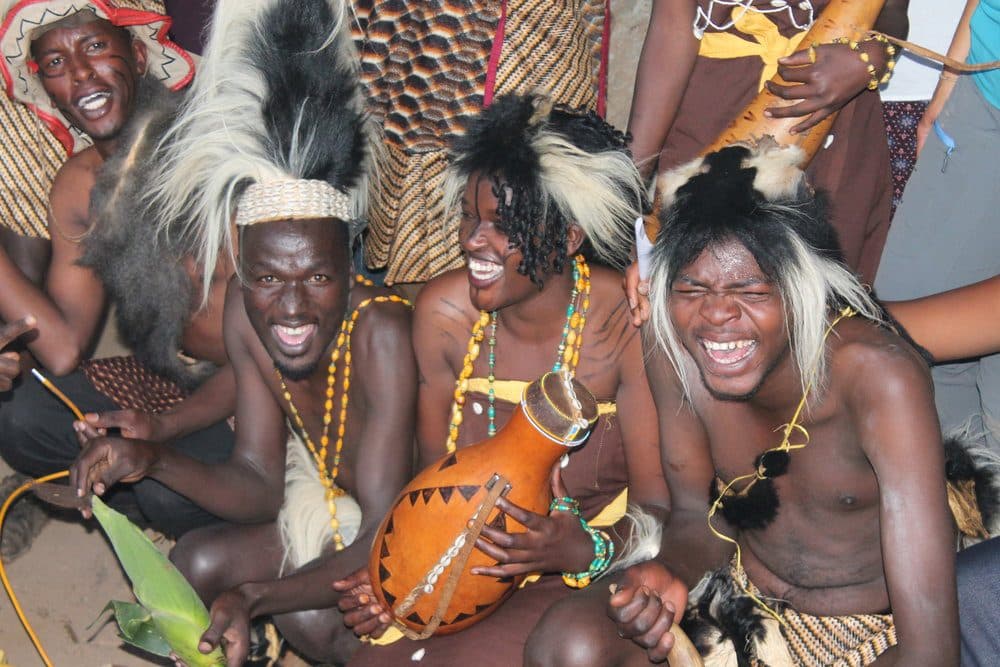
Karamojong traditional wear is practical, expressive, and deeply cultural. Men and women wear brightly coloured cloth wrapped around the body alongside copper bangles, layered beads, feathers, cow-horn rings, and ankle adornments. Sandals made from old car tyres remain common because they survive the rough terrain.
A traditional Karamojong herdsman usually carries four things: a walking stick, a spear, a gourd, and a small stool called an engaberu.
That is enough.
During the long dry season, often lasting three to four months, many men migrate with cattle searching for water and pasture. Women, children, and elders remain in the manyatta waiting for the herds to return.
Development agencies once described this movement as poverty.
But seasonal migration is not poverty.
It is adaptation perfected over generations in a semi-arid land.
By evening, cattle return home through red dust. Elders gather beneath trees discussing disputes, marriages, grazing routes, and community matters.
The elders are not simply resting old men. They are the legal system.
This is not a backward life. It is an ordered one.
Kidepo Valley National Park — Our Land, Your Safari
Most travellers who come to Karamoja in Uganda eventually find themselves in Kidepo Valley National Park.
And truly, it is one of the most beautiful wilderness landscapes in Africa.
According to the Uganda Wildlife Authority, Kidepo Valley National Park covers 1,442 square kilometres and hosts 77 mammal species alongside nearly 476 bird species. Lions move through the savannah. Leopards disappear into rocky hillsides. Elephants cross dry riverbeds at dusk. Zebras, giraffes, buffaloes, and cheetahs roam the plains.
And this is the only park in Uganda where wild ostriches still exist.
But before Kidepo became a national park in 1962 under British colonial administration, much of this land served as traditional grazing territory for the Dodoth Karamojong.
The creation of the park displaced communities from ancestral grazing areas. Responsible tourism should acknowledge this honestly because conservation stories are rarely simple.
Still, relationships between local communities and conservation efforts have evolved over time. Today, the Uganda Wildlife Authority works with communities through collaborative conservation agreements aimed at supporting both wildlife protection and local livelihoods.
The Narus Valley — meaning “muddy ground” in Ngakarimojong — holds water longest during the dry season, drawing wildlife into the open plains and creating extraordinary safari experiences.
But Kidepo is not only about wildlife.
Near the park, the Lorokul Cultural Group organises cultural visits where travellers can enter a manyatta, speak with elders, witness traditional dances, and learn directly about Karamojong culture. According to the community tourism initiative, revenue from these visits has helped support a local clinic and midwife training programmes.
That is tourism at its best.
If you visit, go with an indigenous ranger or book through recognised park management or lodges. The experience becomes richer when the story comes from the people who belong to the land.
Because you did not discover Kidepo.
We have always known it. But we are glad you came.
Kidepo is not only a safari destination. It is one of the clearest windows into the spirit of Karamoja itself. If you want to understand this land more deeply, begin with Kidepo Valley National Park.
In 2011, paleontologists working in the Karamoja sub-region discovered remains of Ugandapithecus major, a 20-million-year-old primate ancestor, proof that this land has carried life and memory far older than any modern border.
You came to see the lions and the ostriches. You will leave thinking about the cattle. About the old men who walked until they could walk no farther, and chose this land. About what it means to measure a life in herds.
Karamoja does not reveal itself quickly. But it does reveal itself. And when it does, it stays with you.
If this land has already begun to linger in your mind, then it may be time to experience it properly; not just as a story, but as something you live through.
Plan your Uganda journey here