
Bird Watching: How to Identify Local Species Like a Pro
Ogundeyi Faith
Bird Watching: How to Identify Local Species Like a Pro
A five-foot prehistoric bird stands motionless in a papyrus swamp, staring straight back at you. No sudden movement. No sound. Just stillness that feels almost ancient. That is the Shoebill Stork.
Most UK bird watchers start small. They spot a robin on a fence. They see a blue tit at a feeder. They notice a blackbird crossing a wet lawn after rain. Ordinary at first glance, until you start paying attention differently. The pause between calls. The flick of movement in hedges. The subtle patterns you once overlooked.
Then something shifts, and bird watching starts to feel bigger than the garden, beyond the UK, but toward places where birdlife feels completely unfiltered.
Understanding Bird Watching
Bird watching is simply the observation of birds in their natural environment. In the UK, though, it has grown into something far more active, one of the country’s fastest-growing nature hobbies.
According to the RSPB, nearly 1 in 5 UK adults now identifies as a bird watcher. From casual garden observers to dedicated field birders.
Today, platforms like eBird extend that experience further, turning personal sightings into part of a global live map of bird activity shared by bird enthusiasts worldwide.
What Is Bird Watching Called?
Bird watching and birding refer to the same activity—though “birding” in the UK often suggests a more active pursuit — going out specifically to find species rather than waiting for them to appear.
Then there is twitching, a distinctly British habit. A twitcher will travel at short notice to see a rare bird that has been reported somewhere else in the country.
At the other end is bird spotting; more relaxed, local, and observational. A bird spotter may not travel far or chase lists, but they are still part of the same world of attention and curiosity.
All of it connects back to one simple idea: noticing more than most people do.
What Are Bird Watchers Called?
There isn’t just one name for it, because there isn’t just one way to do it.
A bird watcher is the general term.
A birder usually suggests someone more committed, often tracking species and building life lists.
A bird enthusiast enjoys the experience without focusing on records.
A bird tracker leans into patterns, migration, and behaviour.
A twitcher is someone who’ll drop everything and travel across the country for a rare sighting. In the UK, it’s practically a subculture, with birders chasing reported rarities and turning up in surprising numbers for a single bird.
And a bird spotter is often the most casual observer, usually local and relaxed.
Different names, same habits.
Essential Gear for Bird Watching
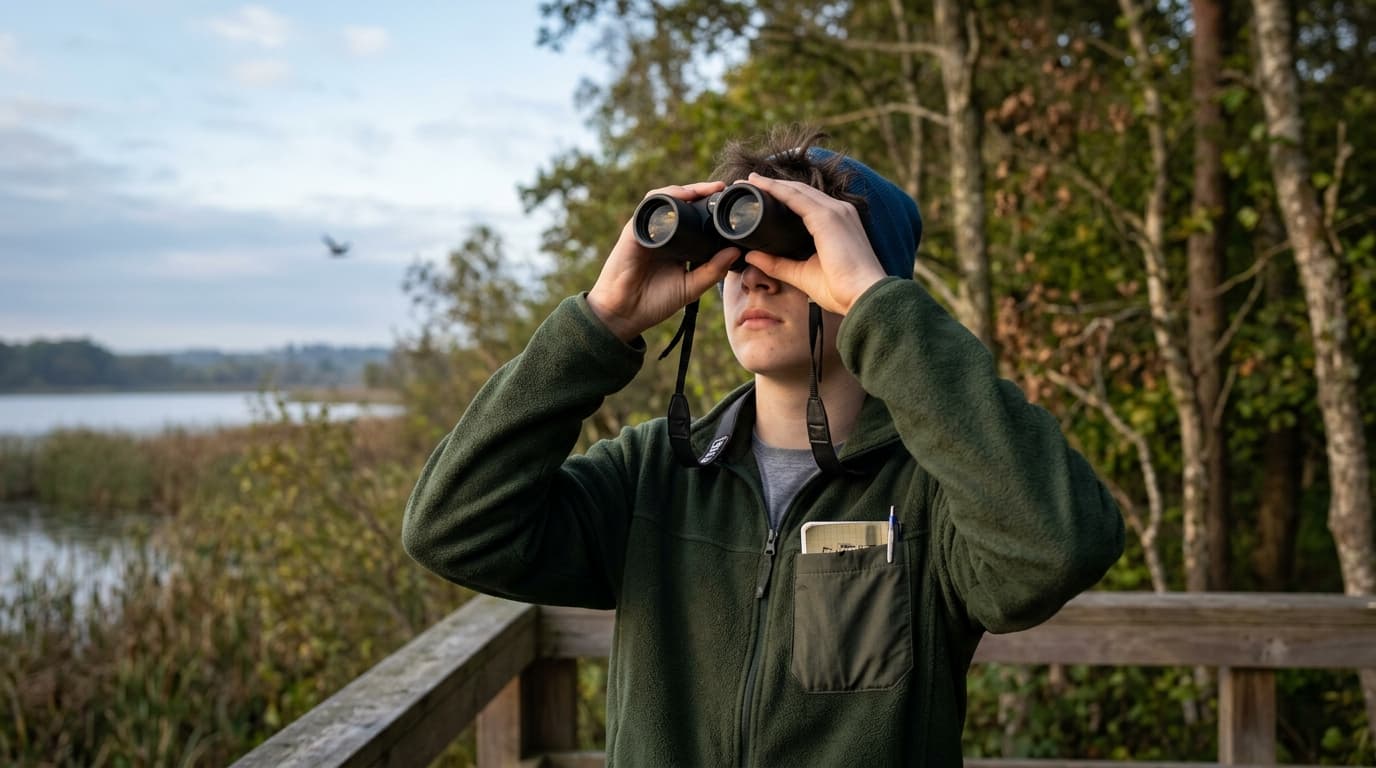
If there’s one piece of birdwatching gear that matters most, it’s a pair of binoculars.
They don’t just bring birds closer, they change what you notice. Feather detail. Subtle colour shifts. Movement patterns you would otherwise miss entirely.
For most beginners, 8x42 binoculars are the standard starting point. The 8x magnification keeps the image stable, while the 42mm lens gives enough brightness for early mornings and cloudy UK skies.
Best bird watching binoculars include:
Swarovski EL 8x42 (premium clarity)
Zeiss Terra ED 8x42 (balanced mid-range option)
Nikon Monarch 5 8x42 (reliable entry-level choice)
Along with binoculars, you only need a few basic items. You will need a field guide. Bring a notebook or the eBird app. Wear a weatherproof jacket. Use sturdy walking boots.
And then there is patience, the only part of birdwatching gear you don’t buy, but end up relying on most.
Honest note: expensive binoculars do not guarantee better birds. Better locations do.
Techniques for Effective Bird Watching
Most beginners make the same mistake with binoculars, they try to find the bird through the lenses.
It works better the other way around. First, locate the bird with your eyes. Then raise the binoculars slowly until they meet that exact point. With practice, it becomes automatic.
Timing matters more than most people expect. Dawn and dusk are the peak activity windows. Then comes habitat reading. Birds often gather at edges: woods meeting fields, reeds meeting water, hedgerows opening into open land. These transition zones are where movement concentrates, so you move slowly and quietly through them.
In dense areas, 80% of birds are heard before they are seen, so start by learning the calls of common UK species, and build from there. Apps like Merlin Bird ID make it easier in real time.
Keep a list too. Use eBird to log bird sightings, discover what others are spotting nearby, and become part of a global community of birders.
Identifying Local Species
This is where observation becomes a skill.
Start with the basics: size and shape compared to birds you already know. Then move closer; plumage patterns, colour variation, and markings that separate similar species.
Bill shape often reveals diet. Behaviour shows how a bird interacts with its environment. Habitat narrows possibilities further. And a call often confirms everything before you even get a clear view.
In the UK, most birdwatchers gain confidence by learning a familiar set of species. These include Robin, Blue Tit, Blackbird, Song Thrush, Goldfinch, Great Tit, Chaffinch, Woodpigeon, and Sparrowhawk. These are the baseline. Once these are solid, you are a birder.
Tools like Merlin Bird ID (Cornell Lab), the Collins Bird Guide, and eBird help birders refine that instinct. They also link your sightings to what others report nearby.
The Best Bird Watching Locations in the World — and Why Uganda Tops Them All
Most UK bird watchers eventually hear the same global destinations repeated: Costa Rica, the Pantanal, parts of India. All exceptional places with rich bird diversity.
But Uganda sits slightly differently in that conversation.
With over 1,090 bird species in a country roughly the size of the UK, it holds one of the highest species densities on earth. Birders recorded up to 665 species in a three week visit.
And then there is the Shoebill Stork —The headline species.
Prehistoric, five feet tall, motionless in the papyrus reeds of Mabamba Swamp, 40 minutes from Entebbe Airport. You arrive, drop your bags, take a canoe, and see one of the most extraordinary birds on earth before you have eaten dinner.
From there, the scale expands. Bwindi Impenetrable Forest has rare Albertine Rift endemics, including the African Green Broadbill. It is hard to see, but patience and a good guide can help.
Kibale National Park brings the Great Blue Turaco through the canopy regularly, and the elusive Green-breasted Pitta for those who arrive early and stay quiet. Queen Elizabeth National Park alone records over 600 species — more than the entire UK list.
What surprises most UK bird watchers isn't that Uganda offers rare birds, it's that it also gives real access to them.
You start encountering everything you learned back home; the binoculars, the fieldcraft, the call recognition, often within minutes of arriving.
That is why many who come for one species end up staying longer than planned.
Uganda Birding Locations — Where It All Comes Together
If you want to take bird watching to its greatest test, here is where to go.
Mabamba Swamp
This is the moment most UK bird watchers come for.
Just 40 minutes from Entebbe, you step into a canoe before the day has properly woken up. The water is still, the papyrus rises on both sides, and everything feels a bit too quiet. Then it appears.
The Shoebill. Motionless. Ancient-looking. Completely unbothered by your presence, like it has been waiting longer than you’ve been bird watching. Other species you'd find here include papyrus Gonolek, Lesser Jacana, Herons,and Kingfishers.
Bwindi Impenetrable Forest
Bwindi is in South-west Uganda and a UNESCO World Heritage Site.
Over 350 species live here; 23 Albertine Rift endemics including African Green Broadbill, Regal Sunbird, and Grauer's Warbler. The forest is dense enough that you rarely see far ahead and birding becomes slower, guided, and often led by sound before sight.
Kibale National Park
Kibale feels alive in a different way. Great Blue Turaco moves through the canopy, African Grey Parrots call from all directions, and if you’re lucky, the Green-breasted Pitta appears briefly before disappearing again. Bigodi Wetland softens the edge where forest meets swamp. It’s in western Uganda, and often combined with chimpanzee trekking along the outstanding Bigodi Wetland trail.
Queen Elizabeth National Park
This is where Uganda opens wide. Endless horizons, water channels, and over 610 recorded species — the highest density in the country. African Skimmers and Kazinga Channel waterbirds line the banks, and on the channel itself, birds gather so closely you stop counting and just take it in. It’s also one of the best places to combine birding with Big Five game viewing.
Murchison Falls National Park
River systems meet savannah here, with wide open views that make spotting easier. Over 450 bird species have been recorded, including Shoebill, Goliath Heron, Abyssinian Ground Hornbill, and Rock Pratincole. It sits in northern Uganda, where the Nile cuts through the landscape and birding feels expansive.
Entebbe Botanical Gardens
Just 5 minutes from the airport, this is a calm first stop in Uganda. It’s ideal for your first morning, easing into birding across six different habitats, with species like the Red-chested Sunbird and African Paradise Flycatcher before heading deeper into the country.
Rwenzori Mountains
Up here, everything slows. Mist hangs in the forest, and sightings come and go in flashes rather than long views. The Rwenzori turaco is the star here, alongside a cluster of Albertine Rift endemics like the Blue-headed Sunbird and Collared Apalis. Birding feels quieter, more deliberate, and often more rewarding for those who stay patient.
You’ve been watching birds in your garden. In the park. On the coast.
Now imagine standing in a papyrus canoe at dawn, watching a five-foot prehistoric bird stare back at you and blink.
That is Uganda. That is the Shoebill. And that is what bird watching is really for.