
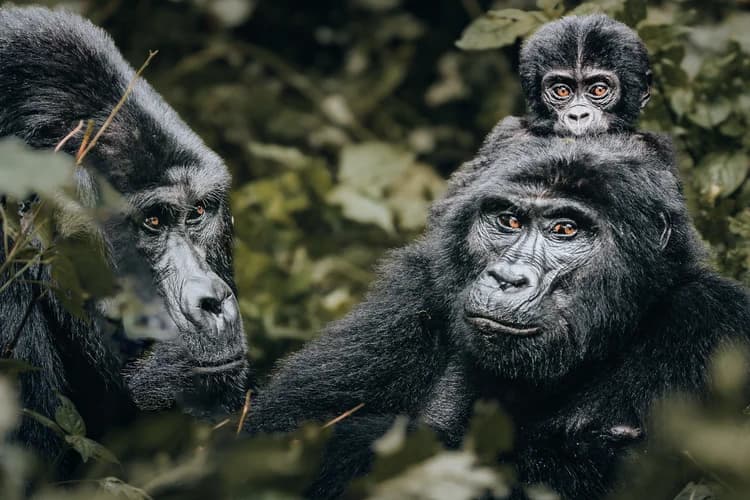
Bwindi Impenetrable National Park
Everything Uganda
Bwindi Impenetrable National Park sits in the Albertine Rift in south-western Uganda — a forest so ancient that it survived the last Ice Age as a glacial refuge, making it one of Africa's oldest ecosystems. The Rukiga word Mubwindi means 'dark, impenetrable place,' and the name earns itself: dense tropical rainforest covering elevations from 1,160 to 2,607 metres, receiving up to 1,500mm of rain annually, woven so thickly that little sunlight reaches the forest floor.
Bwindi is home to approximately 460 mountain gorillas — almost half of the world's remaining population of 1,063 individuals. These are the only great apes with no individuals in captivity anywhere on earth. Twenty-five gorilla groups have been habituated for tourism, spread across four sectors: Buhoma in the north (the most developed, where trekking began in 1993), Ruhija in the east (known for rugged terrain and birding), Rushaga in the south (where the Gorilla Habituation Experience is offered), and Nkuringo in the south-west (the most dramatic scenery, with views of the Virunga volcanoes).
What to Do
Gorilla trekking — groups of eight visitors spend one hour with a habituated gorilla family. Trek time ranges from one to six hours depending on where the family is resting. Permit cost: USD 800 per person for foreign non-residents.
Gorilla Habituation Experience — four hours with a semi-habituated group in Rushaga sector. Limited to four visitors per day. Permit: USD 1,500 per person.
Birding — 350+ species including 23 Albertine Rift endemics. Notable species: African Green Broadbill, Chapin's Flycatcher, Shelley's Crimsonwing, Short-tailed Warbler.
Batwa Cultural Trail — walk the forest with the Batwa people, the original forest-dwellers of Bwindi, whose knowledge of the forest runs 60,000 years deep.
Nature walks — multiple trails including the Munyaga River Trail and Rushura Hill Trail with views across into DRC and Rwanda.
Key Facts
Biodiversity: 120 mammal species, 350+ bird species, 310 butterfly species, 200+ tree species, 104 fern species — among the most biodiverse forests in East Africa.
Also home to chimpanzees (the only place where chimps and mountain gorillas share the same forest), L'Hoest's monkeys, black-and-white colobus, and forest elephants.
Best time to visit: June–September and December–February (dry seasons). Gorilla trekking operates year-round.
Getting there: 8–9 hours by road from Kampala (550km via Masaka or Mbarara). Charter flights available to Kisoro or Kihihi airstrips (approximately 1.5 hours from Entebbe).
Gorilla permits sell out 3–6 months in advance during peak season. Book early.